NO Services - Coronavirus is Spiking so We are Pausing Until Next Week
No Services this Week
Coronavirus is Spiking so We are Pausing Until Next Week
The shul IS NOT open for services this Shabbos due to the spike in coronavirus cases. We will, G-d willing, reopen as soon as it is deemed safe.
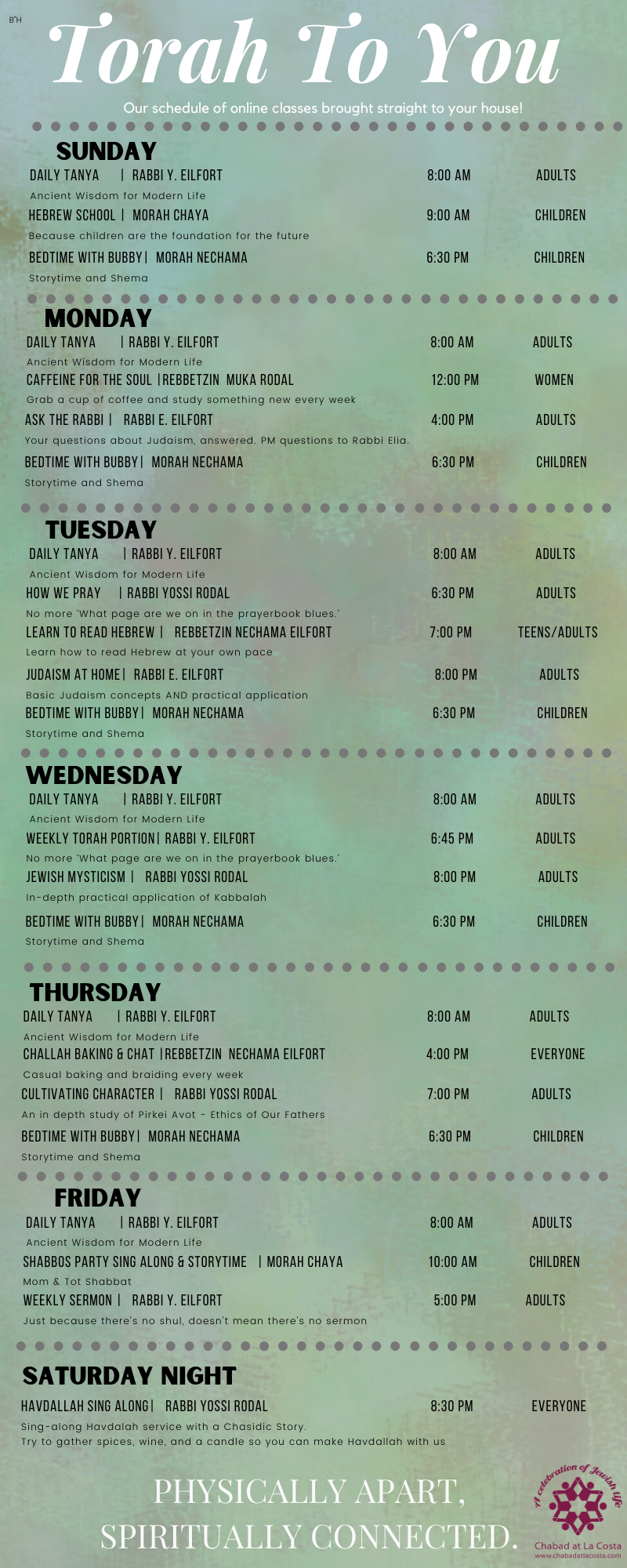
Weekly Sermon Friday @ 5pm on Facebook Live
Join Rabbi Eilfort this afternoon at 5pm as he gives his weekly sermon as a Facebook Live event. If you have not already done so, please send Rabbi Eilfort (Yeruchem Eilfort) a Friend Request on Facebook!
Special Shabbos
This is a special Shabbos in that we bless the upcoming month of Menachem Av, the saddest month of the Jewish year. It is therefore a time of special opportunity. Let us embrace the joyousness of Shabbos and infuse the upcoming month with it so that we can transform a sad month into a time of happiness! It is also Shabbos Chazak, as we complete reading the Book of Numbers. Chazak means strength. May we all glean the needed strength from this Shabbos to finally and completely overcome all of the many tests.
Easy Fundraising Opportunity
First, let us take this opportunity to thank all of those who have had Facebook Birthday Fundraisers for Chabad at La Costa! I cannot tell you how much Nechama & I appreciate it! The money we have received through these fundraisers has helped our shul continue with programming, delivering soup and challah as well as other activities.
Do you have a birthday coming up? We would be honored if you would consider making our shul the recipient of your birthday fundraiser. Wouldn’t it be wonderful to celebrate your birthday and do a wonderful Mitzvah at the same time? Thank you for your consideration and Happy Birthday!
Chicken Soup, Challah Available
Those who live near Chabad at La Costa are welcome to let us know if you want some delicious Challah and/or Chicken Soup delivered to you on Friday to help you celebrate Shabbat in the most delicious way possible.
Please note that all food is prepared and delivered using recommended safeguards.
Sponsors Appreciated (And Needed)
These are extraordinary times. Many people are reaching out for help and, Baruch Hashem / thank G-d, we are HERE to help! ‘We’ means YOU and US, TOGETHER. It is an amazing partnership that we have!
We are extremely grateful to those who have reached out to help fund us, enabling us to serve others.
We would like to specifically acknowledge at this time:
Channah Hale for her generous sponsorship of the Challos.
Miriam Reisman for her sponsorship of the soup.
Moira Markowitz who is co-sponsoring in honor of her father’s Yarzeit; Chaim ben Mattisyahu
We are seeking additional sponsors for the following dedications:
Next week’s Loaves of Love.
Next week’s Chicken soup.
Next week’s Torah classes.
Ways to Give
We would be nowhere without the generous support of our community. Please know that your support is profoundly appreciated!
There are many ways to donate besides for checks and cash. Following please find a list of the various other ‘platforms’ that are available for secure donations that go directly and entirely into the synagogue account.
1. PayPal [email protected] or PayPal.me/Neilfort
2. Venmo @Nechama-Eilfort
3. Cashapp $nechamae
4. Zelle (Bank of America) [email protected]
5. Personal credit card chabadatlacosta.com/donate
Havdala Live with Rabbi Yossi
Join Rabbi Yossi Rodal on Facebook Live on Saturday night at 8:30pm for a meaningful Havdalah service. Following Havdalah Rabbi Yossi will share an uplifting Chasidic story as is traditional on Saturday night.
A Word of Torah
Living with the Times
Parshiot Matot – Maasay (Tribes and Travels)
By: Rabbi Yeruchem Eilfort
This week we read a double portion of Matot – Maasay, which translates as Tribes and Travels. The first portion begins by mentioning the Tribes of Israel. The second portion recounts the forty-two encampments of the Children of Israel during their forty-year sojourn in the desert; from the time they left Egypt until the time they were poised to enter the Holy Land.
When the Torah refers to the 12 Tribes it sometimes uses the Hebrew word ‘Shevatim’ and occasionally uses the word ‘Matot’. The singular form of each word is Shayvet and Matah.
The Rebbe, Rabbi Menachem Mendel Schneerson of righteous memory, asks, “What is the difference between the words and what does this difference teach us?”
Each word not only means ‘tribe’ but it also means ‘branch’. The connection between a tribe and a branch is fairly obvious, as tribes are disparate parts that come from the same source just as branches are. But we find that there are different types of branches; one kind is when the branch is still attached to the tree and/or still has the sap within it, and the other is when it is separate from the tree and the sap has dried out. In the first instance the branch is still supple while in the second instant it has become rigid.
The word Matot, in our portion, is the latter type of branch. It represents the idea that the branch has been separated from the tree and a rigidity has set in. This, at first glance, seems to have a negative connotation when discussing the Jewish people. Emphasizing the fact that they were separated from the Tree (in the metaphor G-d is the Source that we are alluding to) does not seem to be a positive. Intimating that the inner sap has dried and the branch has become rigid also does not seem very positive. This means that the presence of the sap is less discernable, or in the analogue the life-giving sap which emanates from the Almighty, meaning the life force of the Jew, has largely dried up.
But in fact, the Rebbe explains, there can also be a positive to be gleaned from this.
The Matah is much less likely to bend than the Shayvet. Sometimes rigidity is a positive attribute. The Jewish people are described as an ‘Am kishei oref,’ a stiff necked people. That means that we can be very stubborn. While stubbornness can often be considered a serious character flaw there are times when it can be a great character trait. For instance, when one’s neighbors worship idols or embrace some other evil action, and even put pressure on the Jew to engage in such activity, stubbornly clinging to Jewish ethics is a virtue.
We can now understand the connection of these two portions. The (unbending) Tribes of Israel would embark on numerous travels during their forty years in the desert. During that time they would be faced with numerous challenges, hardships, and negative influences. There is no doubt that sometimes the best approach is a ‘bend but do not break’ attitude. There are also times, however, when we must remain rigidly opposed and refuse to compromise our morals. Sometimes, as Jews, we must proactively reject the evil that we see. Often this will be an unpopular position. Nonetheless, we must rigidly and stubbornly reject evil, even popular evil.
It is precisely this approach that enabled our people to navigate the difficulties of the desert and overcome the challenges of inhabiting the Holy Land. It is this approach that will enable us to successfully navigate the harsh tests currently facing our community and nation!
Wishing everyone an uplifting, joyous, and HEALTHY Shabbos!
Haftarah Thought
By: Miriam Reisman in Loving Memory of Harold Reisman on his First Yarzeit
It was my husband’s custom on Shabbat and on Jewish holidays during the many years of our membership with this wonderful Chabad community to comment on the Haftarah or prophetic portion connected to the Torah reading of that day. Harold Reisman, z”l, left this world after a brief illness, exactly one year ago on the 26th of Tammuz, Saturday’s date on the Hebrew calendar. That date is Harold’s first Yartzeit. In loving memory of his beautiful, outstanding and meaningful life, and because of my love for him and devotion to him, I will attempt to make my own brief commentary today.
This is Shabbat Mevarchim, the Shabbat preceding the new month’s arrival and the day on which we bless it. That new month is Av. It is a month of sadness as we remember the destruction of both the First and Second Holy Temples in Jerusalem.
The current three-week period is one of somber remembrance of that tragic time before Tisha B’Av, the ninth day of Av. It is a time of sorrow as we recall that loss. Two Torah portions are read on this Shabbat: Matot and Mass’ei. They deal with the preparation of the Israelites for a joyous entry into the Promised Land. The Haftarot for these two Torah portions, along with a third Haftarah deal with the judgement and suffering to come. In the following weeks there are seven more Haftarot that express redemption and give comfort. These culminate with the arrival of the Jewish New Year. The Haftarot for each of the Torah portions read this Shabbat were written by the prophet, Jeremiah, a prophet who lived during a time of Jewish assimilation into a foreign way of life. Jeremiah warns the Israelites against that, and of its association with sins that will lead to the loss of the Holy Land they so anxiously awaited to enter.
Mass’ei is the final Torah reading in the book of Bamidbar. Its literal translation is “in the desert” but it is known to us as “Numbers.” It contains rules, regulations and a holiness code given to the Israelites during their years of wandering in the desert as they prepared for settlement in the Holy Land.
This Shabbat is also known as Shabbat Chazzak, meaning “strength.” As the Torah reading is completed, the congregation rises and responds with the words, “Chazzak, chazzak Venit’chazzek,” “Let us go from strength to even greater strength,” as is done at the completion of the reading of each book of the Torah. We are now preparing to read the fifth and final book of the Torah, Devarim. Its literal meaning is “words.” These words refer to the laws in Deuteronomy in which laws already given in previous books of the Torah are reiterated.
In our present days of pandemic we are aware of rules and regulations. They are laws to follow. It has been a very difficult time during these last few months. The past year has been beyond difficult. The tragic loss of my beloved husband Harold, his sister Beatrice, Batya, bat Yaakov Yehudah, z’l, my youngest brother, David, Baruch David ben Yoseph Meyer Hakohen, z’l, after a very long illness, my cousin Judah Schwartz, Yehudah Leib, ben Yitzak, z’l, who died from Covid-19 and my many friends who died during this past year, has been terrible. I pray for the health of my three remaining siblings who are suffering varying degrees of illness. I wish Vivian, Aviva Tzela bat Esther Bayla, Charles, Avraham Bezalel, ben Esther Beyla and Cherie, Shulamit Batya bat Esther Beyla each a Refuah Shelemah.
May the memory of Harold, Zvi Dov ben Yaakov Yehudah, z’l, be for a blessing and may his Neshama have an Aliyah. May he, from his place in the Olam Ha’emet, be a source of strength for me, for my children, Jocelyn, Yosepha Zehavah bat Zvi Dov, her husband, Dan Baruch ben Ephraim and Joseph, Yoseph Meyer ben Zvi Dov, his wife, Sara, Shulamit Batya bat Yoel and for all of their incredible offspring who follow.
May we all heed the words of Jeremiah. May we live long and healthy lives always mindful of our Jewish beliefs and of our Jewish identities.